Almost every business owner I'm talking to right now falls into one of three camps. Some are quietly hoping the AI thing will blow over, or that a basic chatbot on the website counts as having "done AI." Some have bought a few tools, automated a couple of obvious things, and feel like they're keeping pace. And a few — far fewer than the headlines suggest — are rebuilding how their business actually operates around what this technology makes possible.
These aren't three flavours of the same strategy. They're three different fates: sink, swim, and surf the wave.
The gap between them is going to be larger than most business leaders currently believe. Here's why.
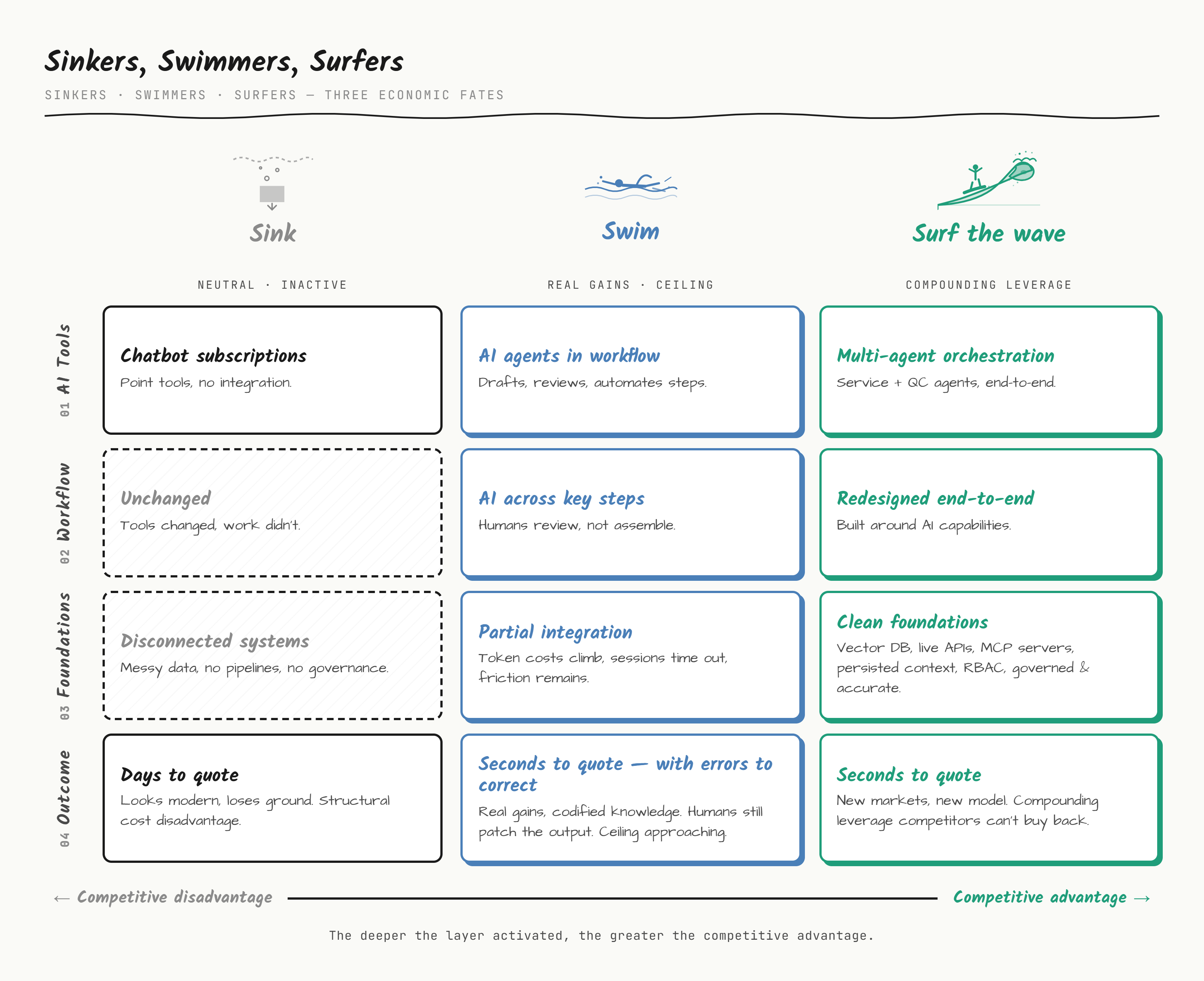
The same business, three very different futures
To keep this concrete, let's follow one business through all three fates. Picture a mid-sized B2B supplier — they sell parts and equipment to other businesses. Their core workflow is easy to describe: an enquiry comes in, someone works out a price, a quote goes back, a rep tries to close it. Hundreds of these a month. Same business, same workflow, three very different futures.
Fate 1 — Sink: The cost of doing the minimum
The sinking version of this supplier isn't doing nothing — it's doing the visible minimum. A chatbot subscription bought for every team member. A separate AI tool the marketing team uses for blog posts. A model one of the junior developers installed without legal approval. A generic chatbot bolted onto the website. Tools everywhere — and not one of them inside the workflow that actually decides cost, speed, and consistency.
Here's how that plays out on a real quote request. A potential customer emails asking for a price. The enquiry still lands in a shared inbox. A rep opens three different files to find pricing, stock, and customer history, pastes everything into a chatbot, and asks it to produce a quote. To the rep's initial delight, it does so quickly — but a decent amount of time still goes into validating and correcting the numbers, because the prompt was rough and the underlying data was messy. The quote still goes back in a day or two, in a spreadsheet, formatted however that particular rep formats things.
The trap is that this looks like progress. The chatbot drafted the quote in a minute where it once took half an hour — but another ten minutes then went into validating what it produced, and the quote still sat in a queue behind everything else. The tools changed; the workflow didn't. And while this supplier admires its new tools, its competitors are quietly rebuilding around theirs.
Fate 2 — Swim: AI as a real operational lever
Now imagine the same supplier, the same enquiry-to-quote workflow — but with AI integrated across every key step.
An AI Sales Agent automatically picks up the enquiry email, interprets what's being asked, opens the same pricing, stock, and customer-history files the rep used to dig through by hand, drafts a quote from a template, and writes a draft email for the rep to review.
The rep still has a few corrections to make — the agent attached a duplicate PDF and forgot to add sales tax — but they're no longer doing every step of the workflow. They're doing the last one, and the one that matters most: the final check before the quote goes out.
This is where the economics start to shift. The largest rigorous study of generative AI in the workplace — Brynjolfsson, Li and Raymond's Generative AI at Work, published in the Quarterly Journal of Economics in 2025 — tracked 5,179 customer support agents through a staggered AI rollout. Productivity went up 14% on average; for novice and low-skilled workers, 34%. The AI essentially codified what top performers were doing and let everyone else catch up.
That's the real prize of swimming: codified knowledge compounds. The gap between your average worker and your best one closes. And that compounding advantage is exactly what sinking businesses aren't capturing.
The swimming supplier still has a ceiling, though. While the agent is faster than what came before, it's still paying the price of bad foundations — token costs climb, sessions time out mid-task, and every disconnected system it has to reach into adds friction and failure points. That ceiling is exactly what the third group goes after.
Fate 3 — Surf the wave: Rebuilt around what AI makes possible
Now imagine the same supplier, the same workflow — but with an AI-first approach. Not bolted on. Not patched together. Built on the right foundations from the ground up.
At this stage, the business stops asking "where can I bolt AI onto what I already do?" and starts asking "what would this workflow look like if I designed it around what AI can actually do?"
Same quote request. But the question isn't "how do we generate quotes faster?" It's "how do we get the customer to say yes faster — and pay faster?"
An AI customer-service agent opens a conversation directly with the customer on the website to understand exactly what they want. It queries a vector database — semantic search over the company's own product documentation — so answers are grounded in real material, not guesswork. A live API call to the pricing-and-stock system confirms what's available and what it costs right now, not what a spreadsheet said last week. A persisted context window carries the full conversation forward so nothing is lost between turns. An MCP server surfaces the customer's history through a role-based access control layer — so the agent sees exactly what it's permitted to see, nothing more: this customer prefers work scheduled for the last Tuesday of the month, and tends to walk away from quotes that don't fit that pattern.
The draft quote then passes to a quality-control agent that re-checks pricing, tests the terms against company policy, and flags anything unusual to a human before it goes out. Nothing is off — so within seconds, the quote is back in the chat window, with the last-Tuesday slot already offered. The customer agrees. A confirmation email and a payment link go out automatically. No rep has touched the enquiry.
None of that smoothness comes from the agents themselves. It comes from the foundation underneath them. Before a single agent went live, the real work went into the data: one clean product-and-pricing model, live stock connected through a governed system, customer history consolidated so the numbers actually agree. The agents sit on top of that. Without it, you don't get validated quotes in seconds — you get quotes in seconds that are quietly wrong.
This is where the economics change dramatically. The swimming business automated the existing workflow. The surfing business redefined the workflow around what AI could do, and rebuilt the foundation to match.
This isn't an efficiency play. It's an economic earthquake.
In a world where the raw cost of intelligence is collapsing, the cost to service and acquire customers will follow. That becomes the new baseline — and once it does, competing at the old cost structure isn't a strategy, it's a slow exit. Those closest to Fate 3 will capture the benefits first and most fully: lower cost to serve, faster response, wider reach. Those still in Fate 1 and 2 won't just be slower — they'll be structurally more expensive to run, serving fewer customers, at worse margins, with no obvious way back.
For those in the Fate 3 camp, once the cost to serve a customer collapses and the workflow runs around the clock, something more significant happens than efficiency gains. The supplier can now profitably serve customers it used to wave away — the small-order long tail, the after-hours enquiries, the adjacent region it never had the coverage for.
This isn't just the old business running cheaper. It's a different business entirely.
The competitors still swimming — let alone sinking — can't easily buy that back. The operational leverage compounding inside a surfing business isn't a feature they can subscribe to. It's the result of foundational decisions made months or years earlier. Those decisions are either your greatest source of competitive advantage right now, or they're becoming your competitors'.
So which one are you?
Before you decide which camp you're in, try this: pick your highest-volume workflow and ask whether AI is inside it, or just nearby.
If your team is pasting data into chatbots and copying the output back into another system, you're sinking — the tools changed, not the work. If AI is handling steps in the workflow and a human is reviewing the output, you're swimming — real gains, real compounding advantage, but a ceiling coming. If you've redesigned the workflow around what AI can do and rebuilt the data underneath it, you're surfing.
Most businesses sitting comfortably in the swimming camp are closer to sinking than they think. And the surfing businesses are moving faster than the headlines suggest.
If you want to work out exactly where your business sits — and which specific process would be the right place to start — that's the conversation I have with clients in a free 30-minute strategy call. Book a time here.